Axis Rush tldr;
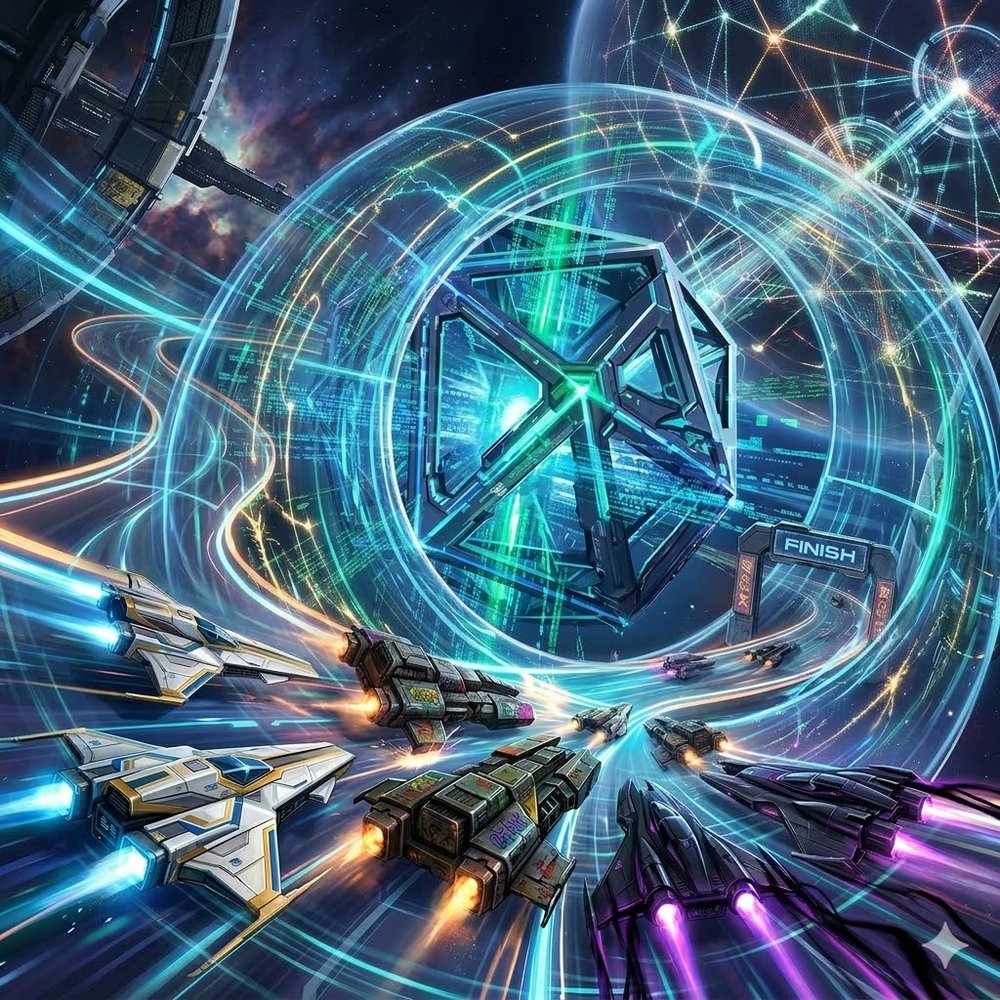
I’ve just released Axis Rush, a futuristic arcade racer inspired by the classics like F-Zero and Wipeout. The twist? You’re racing on a giant cylinder, and you can flip between the inside and outside of the track at will to dodge obstacles or find the perfect racing line.
Take a look at the demo page - Live Demo
Take a look at the code - GitHub Repository
The Vision: Redefining the Racing Line
In most racers, the “line” is two-dimensional. In Axis Rush, its a full 360-degree experience. By allowing players to jump between the Interior and Exterior of the cylindrical track, I wanted to create a game where spatial awareness is just as important as reflexes.
Flipping to the inside gives you a tighter turn radius but limits your visibility, while the outside offers a grand view of the neon-soaked horizon but leaves you exposed.
Features: Beyond the Speed Limit
- Inside/Outside Transition: Use the
Spacebar to phase through the track. It’s not just a visual trick—steering is dynamically inverted while inside to keep the controls intuitive from the player’s perspective. - Procedural Aesthetics: Every texture in the game is baked at runtime using TexGenJS. I used natural language prompts like “neon circuit” and “carbon fiber” to generate GLSL-based textures, keeping the initial bundle size incredibly small.
- High-Inertia Physics: I implemented a “slippery” steering model with an angular velocity system. It feels less like driving a car and more like piloting a high-speed hovercraft with massive momentum.
- 9 Unique Pilots: From the disgraced military pilot Axel Rush to the digital consciousness Korvath, each character has a back-story and a signature color that bleeds into their craft’s neon trails.
- Thumping Techno Engine: The soundtrack isn’t just a static MP3. its a custom-coded Web Audio engine that generates procedural techno beats using oscillators and noise buffers, reacting to your speed.
Tech Deep Dive: Three.js and Post-Processing
1. The Cylindrical Coordinate System
Collision detection on a bending, twisting tube is tricky. Instead of standard XYZ coordinates, I used T-space (progress along the spline) and Angle-space (rotation around the tube). This makes checking if a vehicle is “on the track” or hitting a boost pad a simple 2D range check.
2. Post-Processing Pipeline
To capture that “retro-futuristic” vibe, I used the postprocessing library to layer:
- Motion Blur: To emphasize the extreme speeds.
- Chromatic Aberration: To simulate the visual distortion of a high-G cockpit.
- Pixelation: A subtle toggle that gives it that late-90s arcade feel.
3. Dynamic FOV and Camera Logic
As you hit boost pads or enter a slipstream, the camera’s Field of View (FOV) warps. It’s a classic trick, but combined with Three.js’s camera shake and a “zoom-in” countdown, it creates a visceral sense of acceleration.
Things I was very happy with
- The Transition Mechanic: Getting the camera to smoothly follow the vehicle as it flips from the inside to the outside of the tube without causing motion sickness was a major win.
- TexGen Integration: Seeing a complex, glowing track texture appear from just a few lines of GLSL and a keyword prompt still feels like magic.
- The Audio Engine: Generating a convincing “kick drum” and “hi-hat” purely with code was a fun challenge that paid off in a soundtrack that never sounds exactly the same twice.
Things I wasn’t very happy with
- AI Pathfinding: The AI currently follows a fairly rigid path. While they can dodge obstacles, they don’t yet “think” tactically about flipping inside/outside to overtake the player.
- Collision Response: High-speed collisions between vehicles can sometimes result in “jitter” if the physics steps aren’t perfectly aligned with the frame rate. I’m looking into implementing a sub-stepping physics loop to smooth this out.
What’s Next?
I’m working on a League Mode with a persistent leaderboard and potentially a Track Editor that allows players to draw their own splines in 3D space.
If you want to try your hand at the 2026 League, head over to the GitHub repo and give it a spin!